
Chaz Stevens, First Amendment Activist and Founder of SNITCH
Chaz Stevens is a Deerfield Beach, Florida, First Amendment activist and constitutional litigant. For more than 15 years he has used public-records requests, permit applications, and lawsuits to make Florida governments apply their own rules to everyone, including themselves.
NPR, Fox News, the Associated Press, Time, and Fortune have covered his work. He holds an M.S. in Computer Science and a B.S. in Applied Mathematics, and worked in engineering at IBM, Microsoft, and NASA. He founded SNITCH, which files Florida code-enforcement complaints in its own name, and REVOLT, a governance diagnostics firm.
Learn The Rules
Follow Them Precisely.
The System Works as Designed
Stevens didn't have a single turning point. He reached his conclusion over years of watching government in Deerfield Beach and Broward County: the system works as designed. It protects the people who run it and makes accountability optional for everyone else.
So he skipped the protest signs and read the code. He learned how Florida municipalities operate, how to write Chapter 119 records requests that agencies can't dodge, how press coverage changes what an agency is willing to defend, and what happens when a law gets applied evenly to the people who wrote it.
That knowledge became leverage. A protest gets a news cycle. A public-records request gets a legal obligation to respond.
Same Rules, Applied Evenly
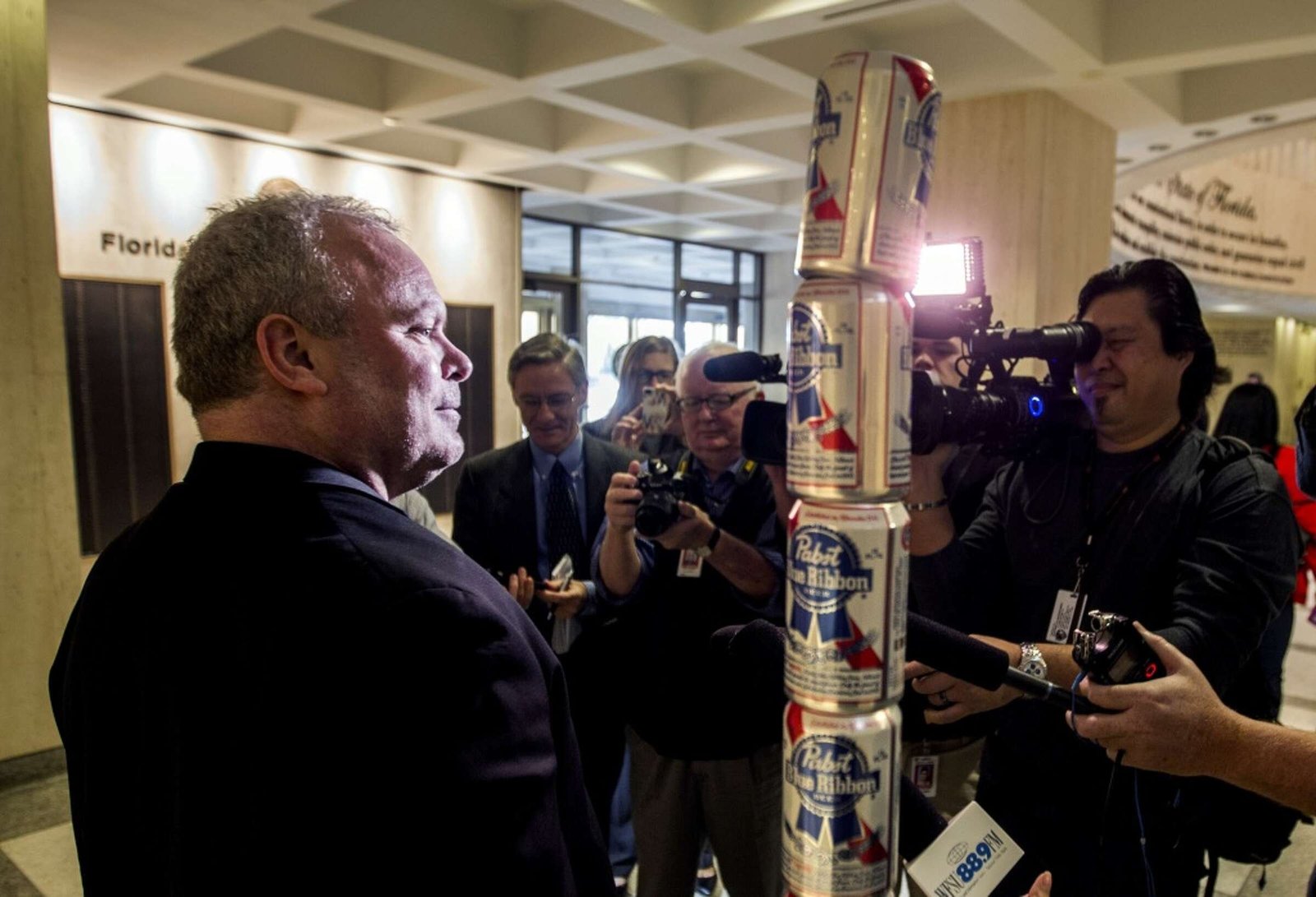
In December 2013, Florida let a Nativity scene into the State Capitol rotunda. Stevens applied for a permit under the same equal-access rules and put up a Festivus pole made of beer cans.
In 2023, Stevens used HB 1069, Florida's new book-objection law, to challenge the Bible in school libraries. The districts had to apply their own removal standards to a book they had no intention of removing.
In [year], he petitioned [city/agency] to post "In God We Trust" in Arabic on [public buildings/schools]. If the motto belongs on government walls, the government has to explain why one language qualifies and another doesn't.
Each challenge ran on a permit, statute, or policy the government had already adopted. SNITCH runs on Chapter 162 the same way.
Why SNITCH Exists
Florida's SB 60 took effect July 1, 2021 (ss. 162.06 and 162.21, Fla. Stat.). Under it, a code enforcement officer can't open an investigation on an anonymous complaint. The complainant must give a name and address first, unless the officer has reason to believe the violation poses an imminent threat to public health, safety, or welfare, or the imminent destruction of habitat or sensitive resources. Under Chapter 119, that name and address become public records, open to anyone who asks, including the property owner.
Most residents decide the exposure isn't worth it. The violation stays.
SNITCH files the complaint in its own name as complainant of record, so the client's name doesn't appear on it. That reduces the client's exposure under Chapter 119. It doesn't eliminate it, and How We File, below, explains why.

File Without Becoming the Story
my name is
Chaz Stevens
And I'd like to introduce myself...
For years, I’ve forced power to backpedal using strategy, disruption, and a deep understanding of how bureaucracy crumbles under its own weight. From exposing corruption to weaponizing bad laws against themselves, I don’t fight fair—I fight to win.
Your move.