
$399. SNITCH signs the complaint, not you.
$399, filed in our name, not yours. Your neighbor never finds out.
Filed across Florida.
You know the violation is real. But filing in your own name means your address on the record — and a neighbor who knows exactly who complained.
Most people never file. The junk pile stays.
SNITCH exists to fix that one problem:
you report it, we take the credit — and the blame.
As Seen On





RIGHTS
Filing a Florida Code Complaint Without Becoming the Story
SNITCH is a Florida-based administrative filing service. We submit qualifying municipal code-enforcement complaints in SNITCH’s name, so you do not have to serve as the named complainant.
A code violation is a code violation regardless of who reports it. Enforcement is about the condition, not the complainant. The problem is that filing exposes you: to a landlord, a neighbor, an HOA, whoever you're reporting, and that exposure is why most people never file.
SNITCH closes that gap. You report a real violation. We review your submission for completeness, confirm the Florida jurisdiction and department, verify the municipality accepts complaints filed by SNITCH, and file it on your behalf.
Be clear-eyed about privacy. Florida's SB 60 (2021) ended unnamed code complaints statewide, with a narrow exception for imminent threats, and a name on a complaint can become public under Chapter 119, the state's public-records law. When SNITCH files as the complainant of record, a records request returns our information rather than yours.
That is not a guarantee your name never surfaces: the posture depends on the municipality, the work product behind a filing may itself be requestable, and we will fully comply with all lawful orders.
What $399 buys you
One code complaint, filed in SNITCH's name, start to finish.
- One code complaint, filed in SNITCH's name, start to finish:
- Complaint drafted and submitted to the correct city or county office
- Your identity kept off the public record
- Photos and documentation packaged to the inspector's standards
- Follow-up on the case status, with updates to you
- If it doesn't qualify, we tell you before you pay a cent
How Code Reporting Works in Florida
How SNITCH Improves Florida Code Enforcement
1. Drop a dime.
Address, what the violation is, photos if you have them. Takes about 5 minutes.
2. We verify and file.
3. You get updates.
We track the case and tell you what happened. SNITCH is the city's point of contact on the complaint.
It Works. Here's Proof.
"The junk-strewn lot next door had been an eyesore for three years. SNITCH filed, the inspector came out within two weeks, and the cleanup order was posted the same month. My name appears nowhere."
- 56 Florida counties served
4 days average time to case opened
How to report a code violation.
If you believe a property violates local codes, you can report it for enforcement action.
1. Submit a Report Online
You Document the Violation.
Photograph the issue, note the address, and describe what you're seeing — overgrown lot, abandoned vehicle, unpermitted construction, whatever it is. You don't need to know the specific code. That's our job.
2. Our Team Reviews Your Report
We Review and File.
Submit your report through our platform. Our team reviews it for completeness, confirms the city or county accepts a complaint filed by SNITCH, and files it with the code enforcement department in our name. Under Florida SB 60, complainants must identify themselves. SNITCH is the complainant you identify.
3. Next Steps & Follow-Up
The System Takes Over.
Once filed, a code enforcement officer is assigned to inspect the property. If a violation is confirmed, the owner receives a notice to comply with a deadline. Fines begin accruing if they don't. SNITCH is the named complainant of record, so your name stays off the filing.
Don't Worry, We Got You.
Starting from $399.
SNITCH files code complaints across Florida
Can't afford to file?
Backers cover it.
Tenants face the worst code violations — and the worst retaliation risk. The Renter Filing Fund pays for qualifying complaints when a tenant can't, and files under SNITCH's name instead of yours.
We've filed your complaint with the appropriate Florida agency under SNITCH's name. A code enforcement officer is assigned to inspect the property, typically within a few business days depending on the municipality.
If the officer confirms a violation, the owner gets a formal notice with a compliance deadline, usually 7 to 30 days. Miss the deadline and the case goes to a Code Enforcement Board or Special Magistrate, where daily fines begin.
Response times from the municipality vary by case and jurisdiction. To check status, reference your report confirmation number when you contact us at go@joesnitch.com. Premium customers get same-day support.
Need urgent legal help?
Around The Office.
Code Enforcement Liens: What Florida Home Buyers Should Check
A Florida code fine can be recorded as a lien on the land, and the code enforcement statute’s seller-disclosure rule covers only one...
Unsafe Rental in Florida: Landlord or Code Enforcement?
Outside an emergency, which goes to 911, unsafe conditions in a Florida rental can go to two places. Write to your landlord first:...
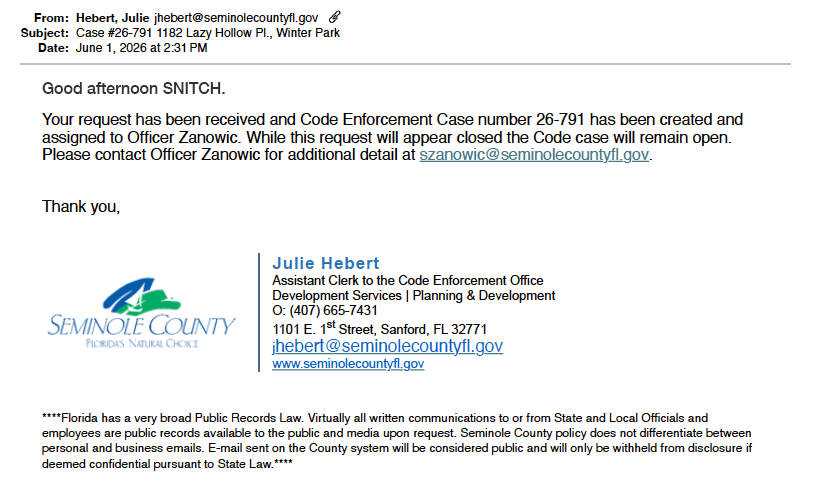
Can SNITCH file in Seminole County? Yes. The county’s website says no. We asked them to pick one.
Short version: SNITCH has already filed a code complaint in Seminole County, by email, under our own name. The county took it, worked...
my name is
Chaz Stevens
And I'd like to introduce myself...
For years, I've forced power to backpedal — using strategy, disruption, and a deep understanding of how bureaucracy crumbles under its own weight. I've turned public-records law into a crowbar, satirical religion into a First Amendment battering ram, and the government's own paperwork into the rope it hangs itself with. From exposing corruption to weaponizing bad laws against the people who wrote them, I don't fight fair. I fight to win.
I've outlasted lawsuits, threats, and officials who assumed I'd eventually go away. I didn't. Every time the machine pushed back, it handed me a new tool. That's the pattern: power overreaches, leaves a seam, and I pull the thread.
SNITCH is the same instinct, aimed at a smaller target — the code violation next door, filed without putting your name in the crosshairs.
Your move.